RIBXCAR · Rib remodeling film
1 min 18 sec · Vertical video
EXPERTISE · AREA A
I first listen to the changes patients want in their body shape and the discomfort they feel in daily life. I assess surgical suitability with chest anatomy and breathing in mind, including ways to reduce scars and discomfort during recovery.
RIB REMODELING FILMS
Two films showing Dr. Seo’s consultation, surgical preparation and operating scenes.
1 min 18 sec · Vertical video
51 sec · Horizontal video
Includes surgical scenes. Rib remodeling carries risks such as pneumothorax, hemothorax, pain, infection and asymmetry. Results and recovery vary. Surgical suitability requires an individual assessment.
I first listen to what troubles the patient and what they hope surgery will change, then consider together whether surgery fits those needs. Even with new techniques, I carefully assess suitability for the individual.
The diaphragm attaches to the lower ribs, with the pleura and lungs immediately inside. Even when the aim is cosmetic, suitability and risk must be assessed as for thoracic surgery.
Scars and discomfort during recovery are part of the treatment plan. I look for ways to reduce them and consider the changes and satisfaction patients feel after returning to daily life.
Both methods retain the ribs and adjust their angle, but differ in access and fixation. da Re-Fit Clinic offers both RIBOSS and RIBXCAR, selecting an approach around the patient’s chest-wall anatomy, desired change and recovery plan.
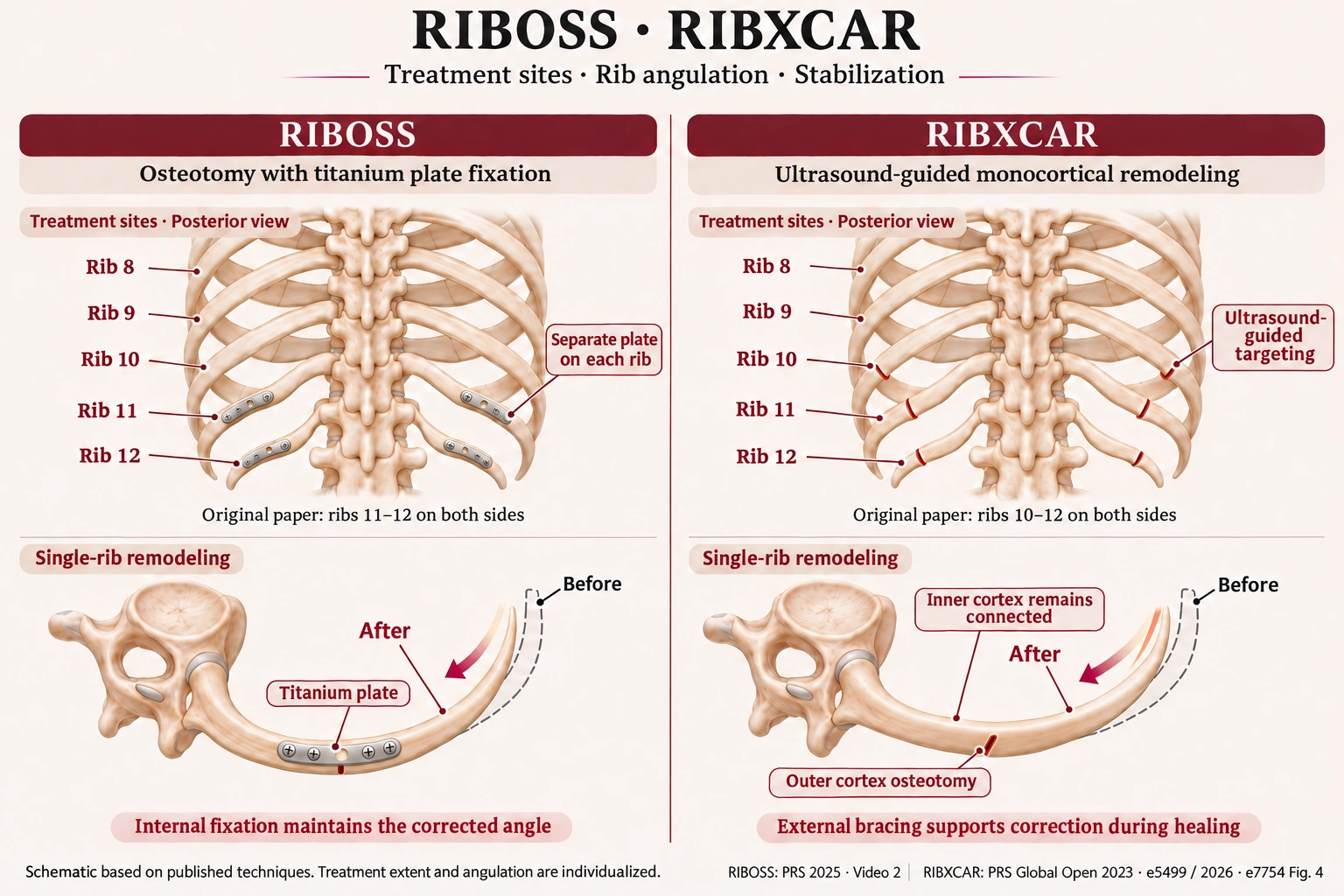
The diagram shows inward rib angulation and the difference between internal plate fixation and support from an external brace.
Rib numbers reflect the original papers. The extent and angle of correction are tailored to each patient.
View larger diagramDiagram references: RIBOSS · 2025 · Video 2 · RIBXCAR · 2023 · RIBXCAR · 2026 · Fig. 4
| What to consider | RIBOSS · Titanium plate fixation | RIBXCAR · Ultrasound-guided percutaneous remodeling |
|---|---|---|
| How the rib is treated | The rib is retained. A limited osteotomy changes its angle, which is then secured with a titanium plate and screws. | Under ultrasound guidance, one cortex is divided and the angle adjusted while retaining the connection on the opposite side. |
| Access and scars | A skin incision is needed to reach the rib and position the plate. The resulting scar is part of the discussion. | Instruments enter through skin punctures. Even small access sites can sustain skin injury or leave scars. |
| Maintaining the corrected angle | An implanted plate provides internal fixation, reducing reliance on a corset for bone stabilization. Compression garments for any combined procedures are planned separately. | No metal plate is implanted. An external brace is an important part of care while the bone heals. How and how long to wear it is individually advised. |
| What to monitor during recovery | The incision, implant-related discomfort, pain and bone healing are assessed. The implications of leaving fixation hardware in the body are discussed. | Brace use, pressure on the skin, pain, maintenance of correction and bone healing are assessed. Discuss whether the care plan fits daily life. |
| What to consider | RIBOSS · Titanium plate fixation | RIBXCAR · Ultrasound-guided percutaneous remodeling |
|---|---|---|
| Advantages | Internal plate fixation can reduce reliance on an external brace for bone stabilization. | Access is through small skin punctures, without implanting a metal plate. |
| Disadvantages and burdens | Skin incisions, scars and the presence of metal fixation hardware in the body need to be considered. Compression garments may still be needed for combined procedures. | Brace use and activity management are important. Even small access sites can develop skin injury, burns or scars. |
An advantage of a procedure may not be an advantage for you.
We plan treatment and recovery together, considering your chest-wall anatomy, desired changes, views on scars and implants, and how brace use would fit your daily life.
I consider your chest-wall anatomy and goals alongside wounds, discomfort and the return to daily life. During consultation, I explain each method’s advantages, burdens and individual risks, and we then agree on an operation and recovery plan suited to you.
Both are operations on the ribs. Risks including pain, bleeding, infection, pneumothorax, hemothorax and asymmetry must be considered, along with individual differences in recovery.
I plan for wound care, comfort and your return to daily life. These are the principles I use to guide my patients through scar care, brace use and recovery.
Before surgery, I explain the expected location and extent of wounds and how to care for them during recovery. RIBOSS requires a skin incision to position the plate; RIBXCAR uses small skin punctures. Even small access sites can develop skin injury, burns or scars, so I assess the wounds after surgery and guide your care accordingly.
RIBOSS fixes the ribs internally with plates. I distinguish a brace for bone stabilization from compression garments needed for combined procedures such as liposuction. I review the extent of your operation and any combined procedures, then advise whether support is needed and for how long.
I tailor brace wear time and pressure to the extent of surgery and bone healing. I explain how to wear it and what to consider in daily life, adjusting the plan as recovery progresses. If you develop pressure-related skin discomfort or pain, contact the clinic instead of enduring it or tightening the brace further. We also confirm together when to reduce or stop wearing it.
At consultation, I ask about your work, usual activity and preferred return date to plan your recovery. Desk work and heavy lifting require different levels of recovery. After surgery, I assess pain, wounds, breathing, combined procedures and practical brace use before advising when to return.
I guide a gradual return, distinguishing light daily activity from strenuous exercise. I advise resuming heavy lifting or exercises that strongly engage the trunk after assessing the surgical site and bone healing. I consider more than pain relief alone and adjust activity type and intensity to your operation and progress.
Recovery time depends on the extent of surgery, combined procedures, health and daily circumstances. I consider the recovery demands of the incision and implants with RIBOSS and brace use with RIBXCAR. I listen to your concerns and return-to-activity goals, and we then agree on a suitable operation and care plan.
Thinking about how to reduce discomfort during recovery starts with treatment planning. Please bring these questions to your consultation too.
What to discuss, from consultation to recovery
Ribs 11–12 end without an anterior attachment; ribs 8–10 connect to the cartilage above. The diaphragm attaches to the inner surfaces of the lower six pairs of ribs and their cartilage.
The ribs are not removed: a limited osteotomy changes their angle, and they are then fixed with titanium plates and screws. A skin incision is needed to place the plates, and the fixation hardware stays in the body. Target ribs, combined procedures and compression garment care depend on the individual plan.
Instruments are introduced through skin punctures under ultrasound guidance to weaken one rib cortex, creating an incomplete fracture and changing its angle. Target ribs, additional maneuvers and brace use depend on the individual plan. This does not mean there is no possibility of skin injury or scarring.
Resection removes part of a rib. RIBOSS and RIBXCAR retain the rib, but retaining it does not mean its structure and function remain identical to before surgery.
The lower ribs move outward during inspiration and support diaphragm movement. Research measuring long-term lung-function changes after altering lower-rib angles in healthy people remains limited.
Reported complications include pneumothorax, hemothorax, persistent pain from intercostal nerve injury, unintended rib fracture, costochondritis, subcutaneous emphysema, infection and asymmetry. A multicenter cohort of 3,805 patients reported four pneumothoraces and one hemothorax.
Risks & adverse effects — Rib remodeling can cause pneumothorax, hemothorax, persistent nerve-related pain, fractures, infection and asymmetry. Long-term follow-up data remain limited. This is general information, not a substitute for an individual consultation.
Treatment, recovery and fees are described on the clinic website.